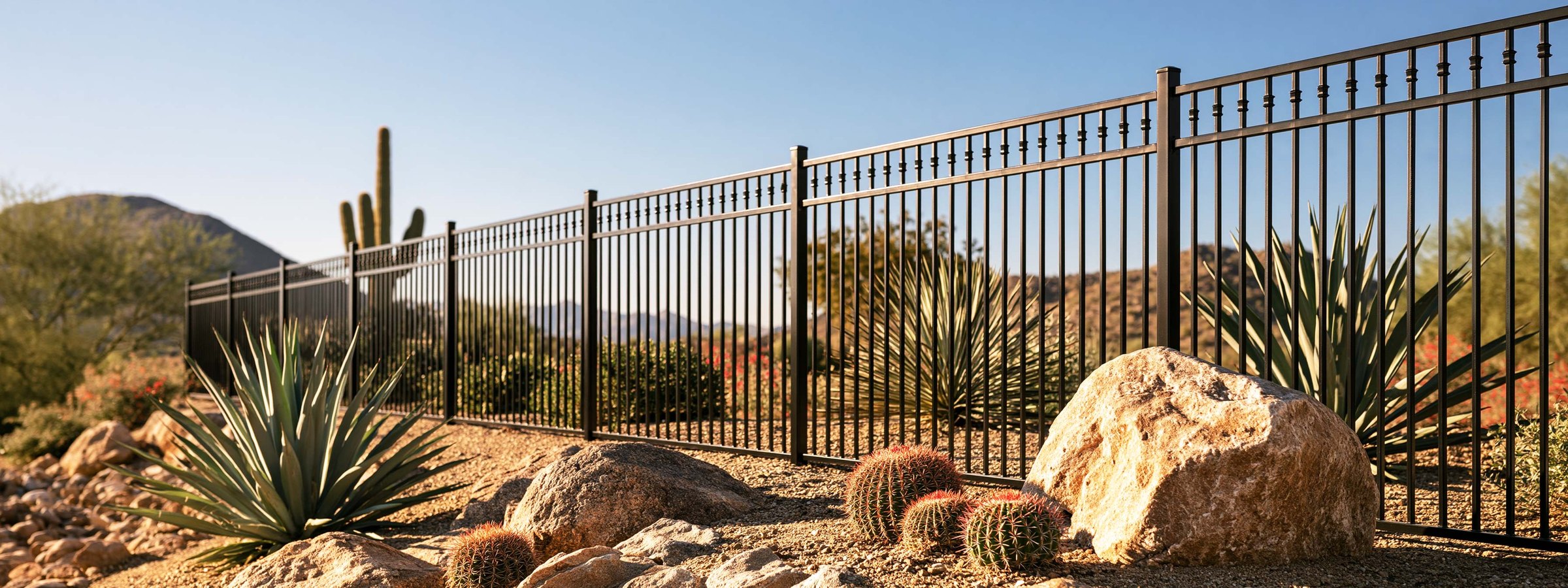
Iron here rusts at the bottom, not along the top. On most fences we look at that's a repair rather than a replacement.
Go and look at the bottom of one upright, right where it goes into the concrete. That's where an iron fence gives out around here, and everything above it is normally sound. A fence that fails in a band two inches tall is a fence you mend, not one you replace.
Now look for the sprinkler head. On a lot of these jobs the cheapest and most useful thing we do is move it a few degrees, and it's worth more to you than anything we weld. A fence taking spray every morning is being watered like a hedge. We'll point yours out whether or not you hire us, because a repair beside a spray head still aimed at the fence is a repair with a date on it.
Ask how long an iron fence lasts and you'll get thirty years from one search result and a hundred from the next, on the same screen. Neither is describing Arizona. Iron here rarely dies of old age. It goes where the water sits. Queen Creek Fence Company starts every wrought iron fence repair estimate at the bottom two inches. If you have view fence, the kind you can see straight through, it's the same metal in the same sun and all of this is yours too.
The metal is rarely the problem. Where the water sits does the damage.
What happens at the ground line. Your fence is coated all over, but not evenly. It goes on thinnest at a cut end, at the join where a picket meets a rail, and on the part buried in concrete. That last one also got handled and scraped on the day it went in. So the thinnest coating on your whole fence sits exactly where the most water sits. The trade calls that spot the ground line.
Water stands there after every watering and works into the join between the metal and the concrete. Rust takes up more room than the steel it came from, so once it starts inside that join it pushes the concrete apart, the gap widens, and the wider gap holds more water. That's why your damage looks as though it started in the concrete.
Irrigation spray is usually the real culprit. Here's the whole difference between a fence at fifteen years and the same fence at forty: whether spray has been hitting the uprights every morning. Our water leaves minerals behind when it dries, and those hold damp against the metal long after the sprinklers shut off.
Turning that head a few degrees, or dropping a drip line in at the base, costs almost nothing next to a repair. It's the difference between doing this once and doing it every few years.
Most people call expecting to replace and end up repairing instead. Your fence decides which, and it's usually clear within a minute of standing at it.
When it's a repair, which is most of the time. If the damage stays at the bottom of the pickets, the slim vertical bars, and the rails they pass through are still solid, you're in the easy case. We cut the bad material back to solid metal, let in new stock of the same size, and dress the join so it doesn't read as a repair from six feet away. Then we prime and paint it to match.
Posts work the same way, just bigger. One that's gone at the ground line gets cut above the damage and joined onto a new base in fresh concrete, so your whole stretch doesn't come out for one upright.
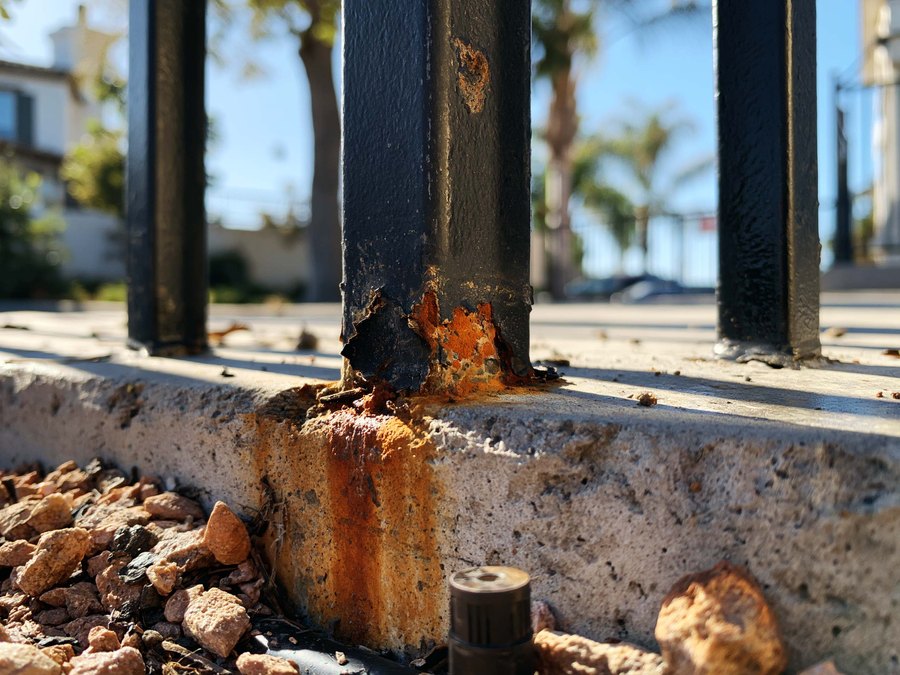
When it's gone past repairing. There's a point where it stops making sense and you'll hear that from us early. Three things say so. The lower rail corroded through along most of its length. Several pickets you can move by hand. Or a fence painted over rust so often there's more paint than steel at the base.
Even then it's usually a stretch rather than the whole fence. Iron fails where the water is, so the west line beside your lawn sprinklers can be finished while the north line of the same age is fine. Replacing what's gone and repairing what hasn't is nearly always cheaper for you.
What you won't get from us is a number of years. Two sources on the first page of a search disagree by seventy, which tells you the figure was never really about iron. It's about water, coating, and whether anybody kept up with either.
Preparation and coating carry the cost of iron work. The metal itself carries the least of it. Cutting a corroded picket out is the quick part; getting the new steel clean, primed and painted is where the money goes.
The rest turns on how much of your fence is involved, and we settle that walking your line with you.
In place, or out on the ground. Small work happens where it stands, so your line and spacing stay exactly as they are. Bigger work comes out: a stretch needing several pickets and a rail let in is better done flat, where it can be squared and welded properly. You'll know which you're getting before anything starts.
The coating is the repair. The weld-and-repaint takes the least time. What decides whether you see us again in three years is everything after it. We take the metal back to sound material and nobody paints over rust. Every fresh cut and new join gets primed while it's still clean. And the paint goes on properly at the base, which is the one place it usually goes on thin, because it's awkward to reach. So the last inch above your concrete gets more attention than anything else on the job.
Five things make one iron repair bigger than another, and they're worth checking when you've got two estimates in front of you:
Nearly always, and more often than the quotes people arrive with suggest. Iron is one of the few fencing materials you can genuinely mend rather than patch. We cut bad metal out, weld new metal of the same size in, and once it's dressed and painted there's nothing to see. Where the damage sits matters more than how bad it looks. At the bottom of your uprights it's the standard job. Along a rail it's bigger, because everything attached has to come off and go back.
New iron runs $25 to $55 a linear foot installed around here. But most of the time you won't need to replace all of it. Iron fails where the water is, so one line of your fence can be finished while the rest is fine, and repairing what hasn't gone is nearly always cheaper. Where you land inside that band comes off the height and how much metal is in the product. Add your gates, and whether the old fence and its concrete have to come out first.
Water decides it here. Search it and you'll be told thirty years by one result and a hundred by the next, on the same screen. Neither is describing this climate. What decides yours is whether water stands at the base and whether anybody ever moved the sprinkler. Two identical fences on the same street can sit twenty years apart in condition.
The slim vertical bars are pickets. The horizontals they pass through are rails, usually two and sometimes three. The thicker uprights set into concrete at intervals are posts, and they carry everything you see. The decorative tip on top of a picket is a finial, and on a plain fence there may be none at all. And where the metal meets its concrete or the dirt is the ground line, which is less a part than a place. Those five words make any estimate you're handed a lot easier to read.
Figure $30 to $50 a linear foot. A railing is short, so the material barely registers and almost the whole price is access and finishing. One beside steps or on a raised patio takes longer to work on safely than the same length standing in a yard. And a railing you put your hands on has to be finished more carefully than a fence nobody touches. The damage is usually at the base of the uprights, as it is on anything set into concrete outdoors. Your railing then gets exactly what the fence gets: cut back, let in new metal, weld and repaint.
Nobody publishes one for this valley, and it would be two answers blended into one anyway: fences that get watered and fences that don't. The ones we see at fifteen years are nearly always on the sprinkler side of your yard. The ones still fine at thirty are on a line the irrigation never reached.
What Queen Creek asks for around water, and the details that fail an inspection.
Pool fencing →The powered half of a driveway gate, when it starts behaving oddly.
Automatic gate repair →Desert-edge lots where the fence is there to keep the view, not block it.
Gold Canyon →Whole streets fenced in the same metal within the same few years.
San Tan Valley →
Free, no obligation
A close picture of where one upright meets its concrete tells us more than a picture of the whole line, because that's where your answer is.
