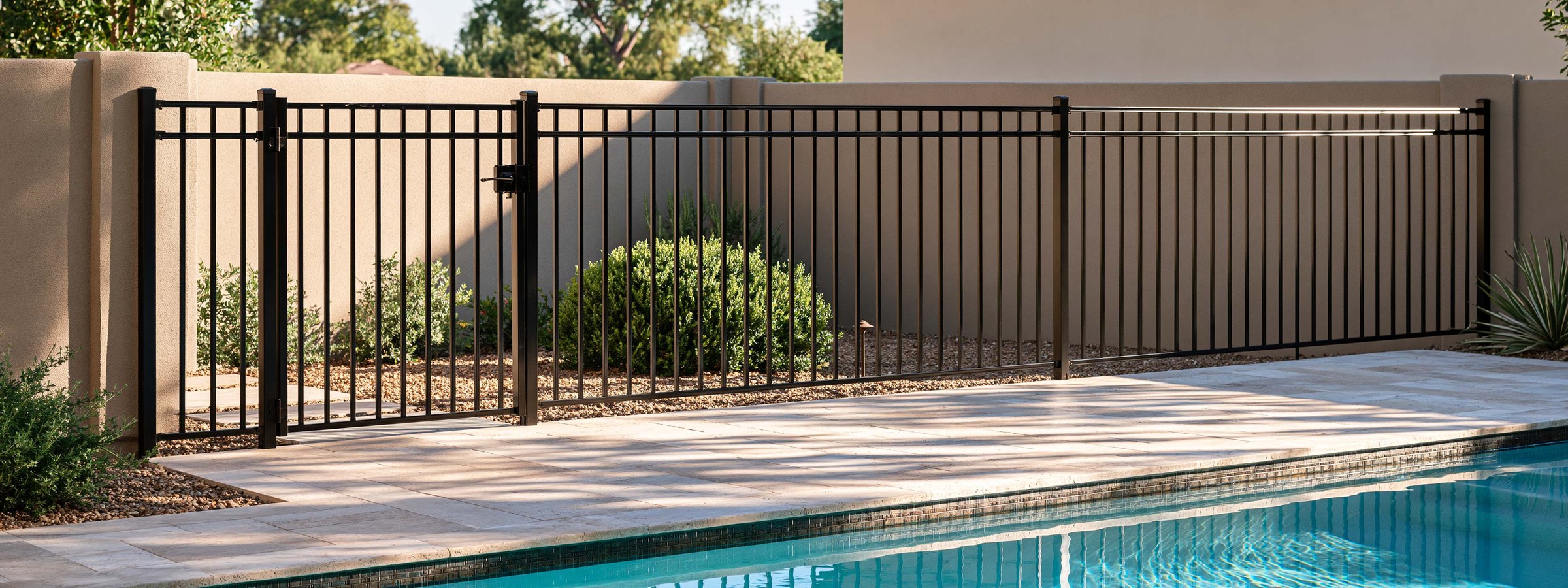
Queen Creek requires a barrier around every pool, above-ground included. We build to the published standard and pull the permit.
You're probably here for one of three reasons. There's a pool going in and the barrier has to be up before the final inspection. Your house is selling and a buyer's inspector wrote it up. Or you looked at the yard and did the math on a kid who's just started walking.
Every one of them lands in the same place. Queen Creek requires a barrier for every pool, and that includes above-ground. There's no pool small enough to be exempt.
Before you price a fence, though, here's something worth knowing: a lot of these calls turn out to be a repair rather than a new barrier. A latch moved up, a gate rehung to swing the other way, a gap closed at the bottom. If that's your yard, it costs a fraction of what you're bracing for. Queen Creek Fence Company would rather tell you that on the phone than after you've budgeted for a whole pool fence installation.
The rules come from two places and they stack. Arizona's statute sets the floor for the whole state. Queen Creek adopted its own requirements in Town Ordinance No. 479-10, effective June 19, 2010, and publishes a Pools, Spas and Hot Tub Commentary alongside it. Where the two differ, you build to the stricter one. We start with the standard and work out to the style, so you pick the look once the shape is settled. All of this is general information rather than a code determination, and the inspector decides.
The town doesn't leave you to work it out. Its pool barrier page names two arrangements, and between them they cover almost every back yard around here.
Three sides, plus something on the fourth. A five-foot fence on three sides of the pool, plus either a motorized safety pool cover or a ground-level door that's self-closing and self-latching. That's the usual answer where your house forms the fourth side, which it normally does. The state statute also allows a four-foot barrier between the pool and the living area on that side. It carries conditions on any door or window opening onto the water, and we'll walk those with you.
Five feet, all the way around. Fences at five feet on every side. Simpler to inspect, simpler to explain to a buyer years later, and it's the one we build most often where there's room, because it takes your house out of the question. On an acre lot it comes in cheaper than people expect, since only the water needs enclosing. Fence the pool and leave the acre to your property fence.
Then the state list, which a tape measure settles. Your pool counts if the water reaches eighteen inches deep at any point and runs wider than eight feet at any point, above ground or below. From there the barrier stands at least five feet high, measured on the outside. It sits at least twenty inches back from the water's edge. And it passes no four-inch sphere anywhere in it, including the gaps you stop noticing after a week.
Horizontal members sit at least forty-five inches apart vertically, or the gaps between them come down to no more than one and three-quarter inches. Wire mesh holds to the same figure. Your gates close by themselves and latch by themselves, the latch sits at least fifty-four inches up, and the gate swings outward, away from the water.
Both town arrangements carry restrictions that live in the ordinance and the commentary rather than on the web page, and local rules can be stricter than the state minimum. So we confirm the current standard against your address before anything gets quoted.
Most barriers we build have a deadline attached, and it's normally one of two.
A pool is permitted work in Queen Creek, same as a fence, and permitted work ends with somebody from the town looking at it. Your barrier is part of that. What we see constantly is a pool company and a fence company who have never spoken to each other, and the fence ends up squeezed between finished water and a final inspection. Booked early it's an ordinary job.
The other one turns up when a house sells. A pool barrier is a standard thing for a buyer's inspector to write up, and it lands in the middle of a transaction with a date attached. Those are nearly always repairs.
That's what we see rather than a rule anybody publishes. Neither the statute nor the town names a trigger. Both apply the whole time there's water in the pool, which is the real answer.
And one thing you won't get from us: there are exemptions written into the state statute, and we don't hand those to anybody. Queen Creek doesn't repeat them, and the inspector is the one who decides.
The shape of your yard carries more of this price than the fence does, which surprises most people. Every corner your barrier turns adds feet, and feet are what you're paying for.
One decision moves it more than all the rest together: which of the two arrangements your yard suits. We walk the line with you and settle that in ten minutes.
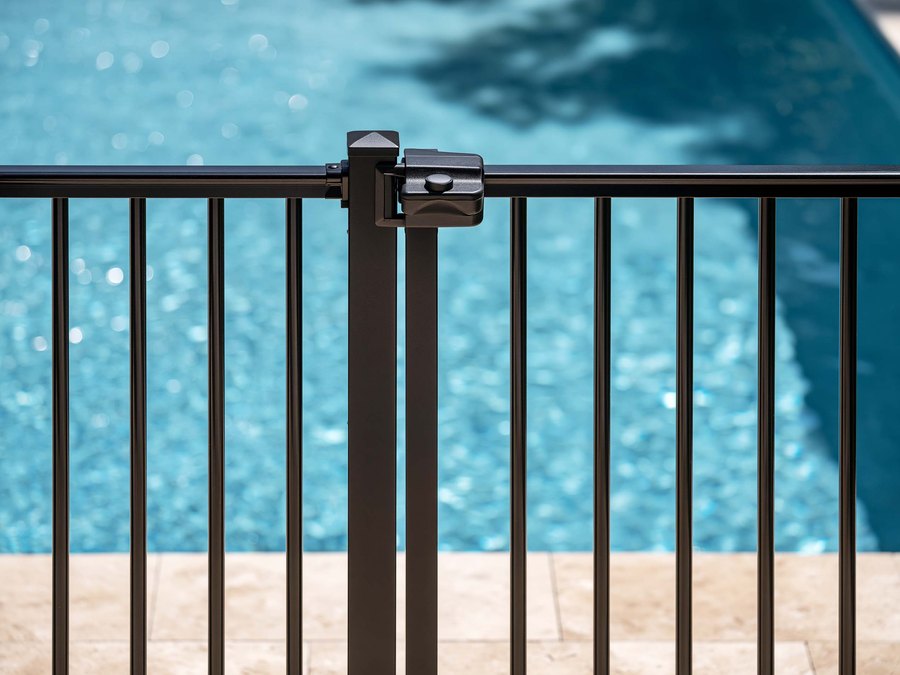
Nearly every failure we get called out to fix is at the gate. Yours has to close by itself from any position you let go of it, not just from halfway, and it has to catch every time. The latch sits at least fifty-four inches up, which is higher than feels natural, and that's the point of it. And it swings away from the water.
So we set the gate first and build the fence to it. Hanging a gate into whatever gap is left at the end is how a barrier ends up almost right. We size the hardware for something that kids and wind are going to push several times a day for years.
Before we call it done we walk it against the same list an inspector uses, and you're welcome to walk it with us:
Then the paperwork. We prepare and file it, and the permit sits itemized on your estimate.
A barrier on all swimming pools, above ground and in-ground alike. The town's own page names two ways to satisfy it. One is a five-foot fence on three sides, together with either a motorized safety pool cover or a ground-level self-closing, self-latching door. The other is five-foot fences on all sides, which is where most people land. The detail behind both lives in Town Ordinance No. 479-10, effective June 19, 2010, and in the town's Pools, Spas and Hot Tub Commentary. Underneath those sit the state requirements on height, gaps, gate hardware and latch height. General information rather than a code determination for your yard, and the inspector has the final say.
Budget $25 to $55 a foot installed for tubular steel, which is what most barriers here are. Removable mesh runs less, roughly $18 to $30 a foot. Add $300 to $800 for the self-closing, self-latching gate, and that part isn't optional. Most back yards need sixty to a hundred and fifty feet, so that's your arithmetic. What moves you inside the band is the shape of your yard, how many gates you need, and what you're digging into.
In Queen Creek, yes. The town's wording covers both above and in-ground pools, and there's no local exception for a temporary or seasonal one. The state test is about the water rather than the structure: at least eighteen inches deep at any point and wider than eight feet at any point brings your pool in. The state does allow an arrangement built around the pool's own walls, where those walls can't be climbed and the ladder is removable and secured. That's a specific set of conditions rather than a general exemption, and the inspector decides whether yours meets them.
At least five feet, measured on the outside face, the side somebody would be standing on to get over it. That's the height in the state statute and in both arrangements Queen Creek names. Measuring on the outside matters more than it sounds: a fence standing five feet above your pool deck can be well under five feet from the ground behind it where the grade drops away. It's one of the commonest reasons a barrier that looked right on the drawing doesn't measure right on the day.
Two mechanisms doing two jobs. Self-closing means your gate returns and shuts on its own from any position you release it from, with nobody helping it. Self-latching means that when it shuts, it catches. Every time. The latch has to sit at least fifty-four inches above the ground, deliberately higher than an adult finds convenient, and the gate swings outward, away from the water. Hardware wears, so this is the part worth testing a few times a year. Let the gate go from a few different positions and listen for the catch.
We build to the published list and we walk the finished job against it with you before we leave. What you'll never get from us is a promise about an outcome that belongs to somebody else. The inspector decides, and local rules can be stricter than the state minimum. What you will have is a barrier where you know which rule every detail is answering. If something does get flagged, we come back out and deal with it.
The same metal in a different job, repaired, recoated or replaced.
Wrought iron and view fence →New wall built to the standard your lot actually calls for.
Block wall construction →
Free, no obligation
The shape of your yard decides this job more than the size of your pool does, so a photograph looking back at the house from the water tells us the most.
