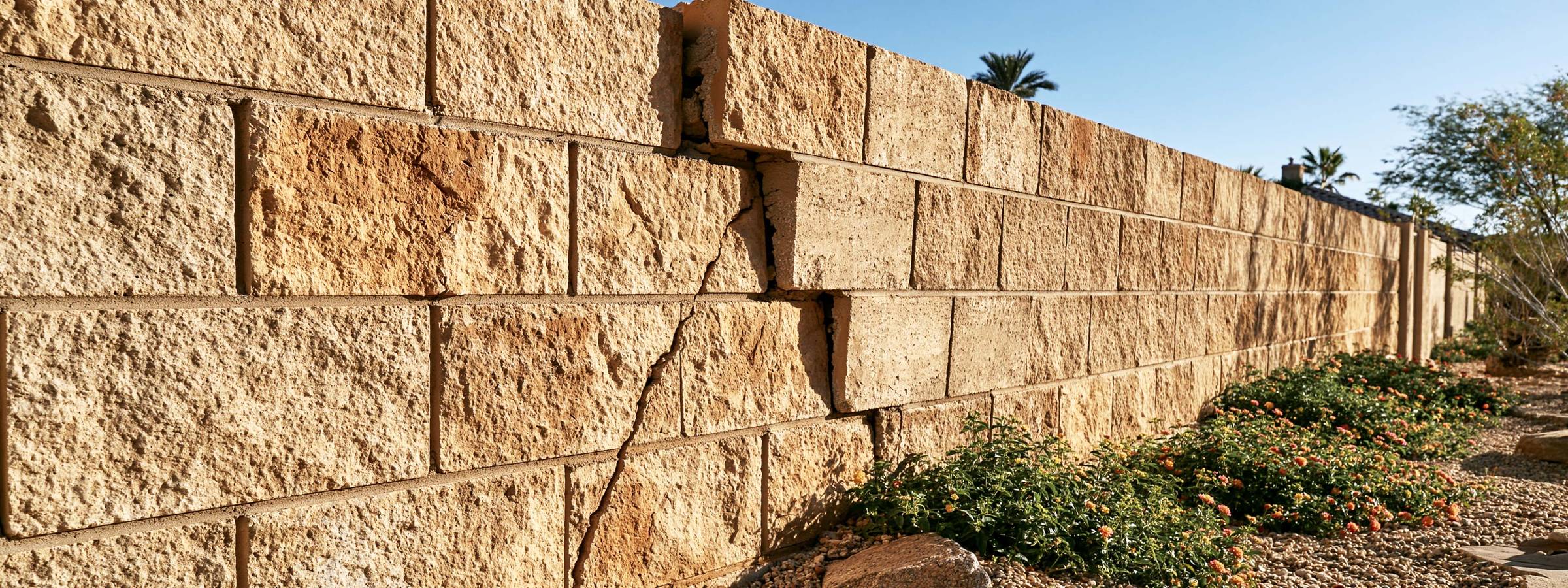
Usually it's one section that's moved, not the whole wall. Send us two photos and we can often tell you which before we drive out.
Maybe you've found a crack stepping down through the mortar joints. Maybe you've sighted along the top of your wall and watched one stretch wander off the line. Either way you want to know one thing: whether you're about to buy a new wall.
Usually not. Most of the walls we get called out to have moved in one place, and the rest of the wall is fine.
So here's something it isn't in our interest to tell you. Send two photographs, one of the damage and one of the base where the wall meets the dirt, and we can often say what you're dealing with without driving out at all. Sometimes that answer is that it's cosmetic and you don't need us this year. Queen Creek Fence Company has repaired block walls in most neighborhoods around here, and block wall repair is the bulk of what we do.
Most of the walls we repair aren't old. Queen Creek largely went up in the last twenty years. They've just been standing on ground that moves.
It's nearly always water. There's a hard layer under a lot of this valley called caliche, and water doesn't pass through it. So the hole your footing sits in behaves like a bucket. The water arrives and then it has nowhere to go. Some ground here also swells as it takes on moisture and shrinks as it dries out. Either way the footing shifts a fraction, and your wall reports it up where you can see it.
That's why these calls come in September. Not because monsoon wind shoved a wall over, but because eight weeks of water got underneath it.
Queen Creek also publishes maps of earth fissures, and the Arizona Geological Survey maps the Chandler Heights area. For nearly every property it changes nothing about your wall, but checking takes a couple of minutes and we'd rather know than assume.
We'll usually know within a few minutes of standing at it. Four things decide it:
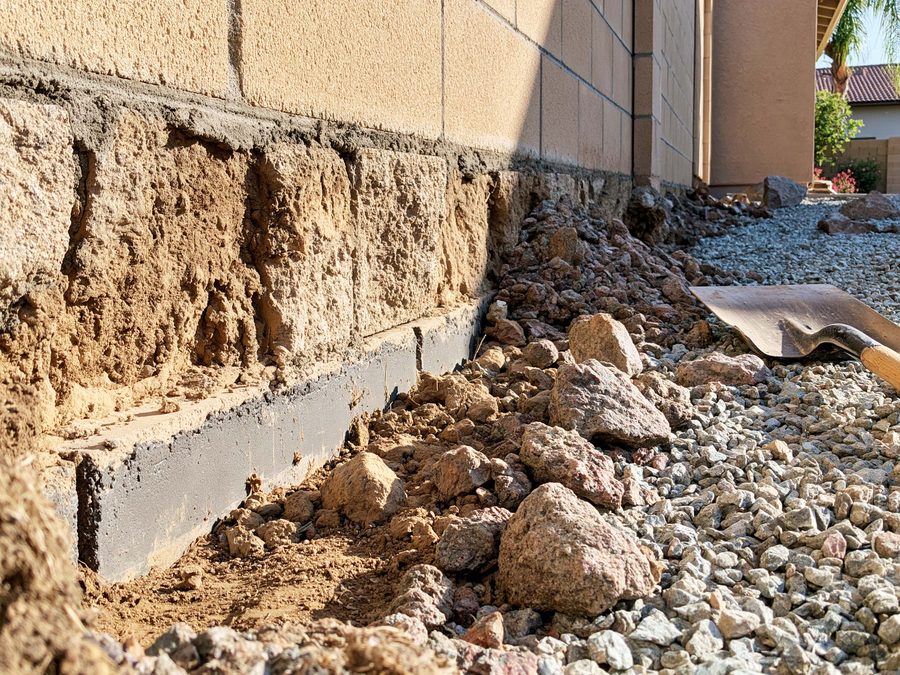
Sometimes a rebuild is the honest answer and we'll say so. If the cracking repeats along the length, if several stretches lean by different amounts, or if the footing has clearly traveled, repairing it just means paying twice.
Rust stains bleeding out of the block are the same conversation. Once the steel inside starts to corrode it swells and splits the block from within, and there's no surface fix for that. Anyone who tells you otherwise is selling you a coating.
Either way you'll know which one you have, and why, before you get a price.
Nearly every line on a wall repair estimate traces back to your footing. And one thing outweighs all the rest put together: how much of your wall the repair actually touches.
So we walk the whole length with you, dig at the base where the movement shows, and mark the stretches that are holding, before anything gets written down.
Queen Creek requires a permit for a fence or a wall, and there's no height you can stay under to skip it. The town publishes standard details for four-inch interlocking block and for six- and eight-inch masonry, so most repairs build to one of those without an engineer. We pull it and handle the paperwork. Rules change and the inspector has the final say.
On the day, we walk your property line first. A wall on the line is partly your neighbor's, and that's a much easier conversation to have before the work than during it. Then we call in the utility locate and open the ground at the base.
We take the damaged section out to a clean joint, so the new block has a square edge to key into. If your footing moved, we rebuild the footing. That's the part that gets skipped, because nobody can see it afterward and it's the most expensive thing in the hole. Then the block goes back with the steel and grout your wall height calls for, matched as closely to what's beside it as we can get.
Usually it's the face rather than the wall, and water with nowhere to go is behind most of it. If your wall still stands straight and the joints hold, we take the loose material back to something solid and rebuild the face. Then we deal with whatever put the water there: a sprinkler head aimed at the base, or dirt piled against it. Fix the face and leave the water and you'll be doing this again in three years.
Find the water before you touch the block. Out here it's nearly always irrigation rather than rain, because rain is brief and irrigation lands every week for twenty years. Look for a spray pattern hitting the wall, a low spot that holds water after a storm, or dirt built up against the base. Sealing a wet wall traps the moisture inside it, so we'll move a sprinkler head for you before anybody mentions a coating.
What the gap is doing decides it. A hairline opening that hasn't changed in two years is cosmetic. We rake the failed mortar back and pack fresh mortar in, color matched and finished to the same joint shape. A gap that's wider at one end, or that has grown since you first noticed it, is a different animal. That one is your wall telling you the ground under one side has moved, and filling it erases the measurement you'll want next year.
Yes, but almost nobody in Arizona works with the second one. True cinder block used coal cinders as aggregate, which made it lighter and a good deal weaker. What's standing in your yard is concrete masonry, stronger and heavier. People here use both names for the same thing and no harm comes of it. It only matters if you're reading repair advice written for a colder, wetter part of the country.
On a free-standing property wall, coverage usually turns on the cause rather than the damage. A wall knocked flat by a monsoon is a different claim from one that settled slowly over ten years, and most policies treat gradual movement as maintenance. Your own declarations page is the only place that answers it, so have a look before anybody quotes you. And if you mean a wall built to hold back a slope, we don't take that work at all. Different license class, and you want somebody who does only that.
Most one-section repairs land between $500 and $1,500. What takes a job above that is the footing. If the ground under your wall has moved and the footing has to come out and go back, you're into a different order of work. From the street you can't tell the two apart. That's why the first visit digs at the base instead of guessing, and why the footing gets its own line on your estimate. Damage repeating along the length is a rebuild, and we'll say so.
A new wall built to the standard your lot actually calls for.
Block wall construction →Wind finds the weak post first. Most storm jobs are smaller than they look.
Fence repair →Whole subdivisions there reached the same age at the same time.
San Tan Valley →Acre lots, horse ground and manufactured-home parcels, quoted differently.
Apache Junction →
Free, no obligation
One photograph of the damage and one of the base where it meets the dirt is usually enough for us to tell you what we're looking at before we load the truck.
