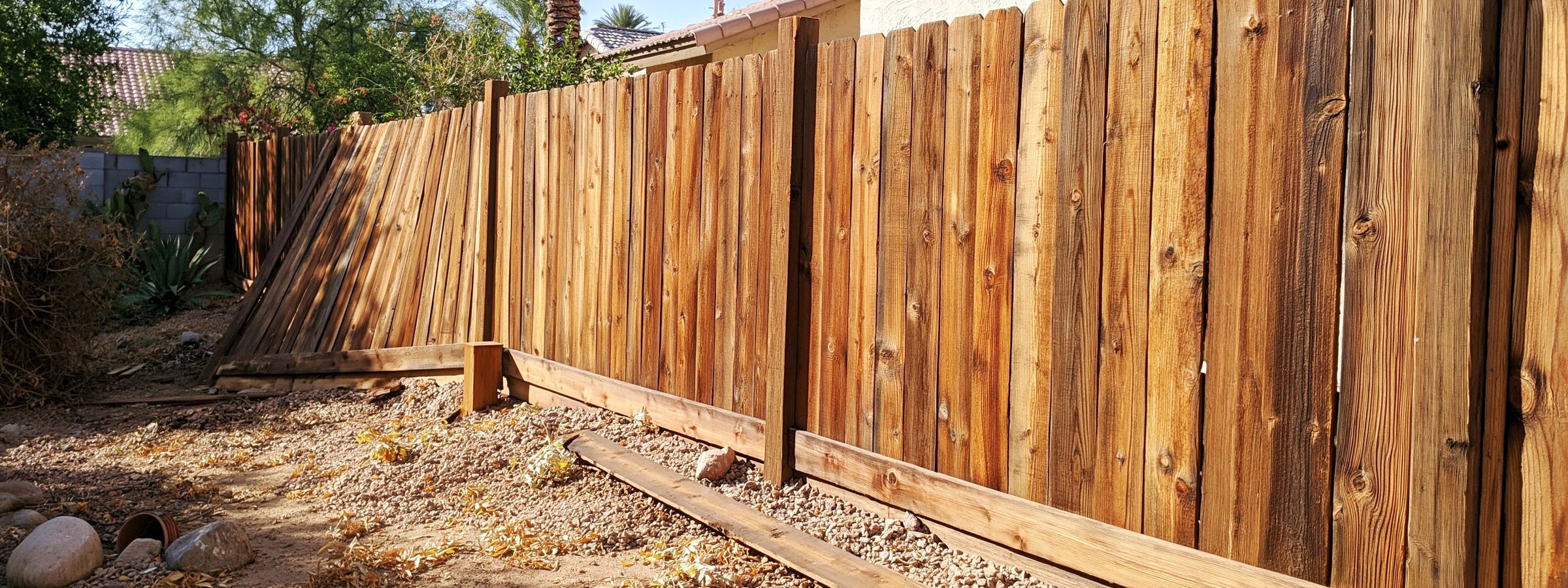
One bad section doesn't mean a bad fence. Usually it's a single post that has given up while the rest still has years left in it.
One question is worth settling before anything else: did one part of your fence fail, or is the whole thing at the end of its life? A lot of money sits between those two answers, and from the driveway they look the same.
In Queen Creek it's nearly always the first one. Whole streets went in at once here, so your fence and your neighbors' went up in the same few weeks out of the same material. A fence like that doesn't wear out evenly. It gives way at its weakest point, and that point is nearly always a post.
Here's how you can check before you call anybody. Walk your line and put a shoulder into every post. If one or two move and the rest are solid, you're looking at an afternoon. If a third of them give, you're renting a little more time on a fence that's finished. And you should hear that from whoever you call before they take the small job twice. Queen Creek Fence Company prices the failed part rather than the whole fence, and on most fence repair in this town that's the difference between an afternoon and a weekend.
Your fence doesn't fail all over and it doesn't fail in the middle. It fails where something was already marginal, and the first serious wind of the summer goes and finds it.
What the summer storms actually do. Your fence works like a sail. Every square foot of solid wood or vinyl catches wind and all of it arrives at the posts. A monsoon downburst lands in one place, hard, and goes looking for whichever post was holding the least.
The rain matters more than the wind, and it matters afterward. Your ground goes from bone dry to saturated in twenty minutes, so a post standing in wet dirt has far less holding it than it had that morning. That's why a fence can stand through the storm and go over two days later with no weather at all. We get that call all summer.
Why the ground here is hard on a post. Under a lot of this valley is caliche, a hard cemented layer. It does two things and neither is good. A crew digging post holes in a hurry hits it and stops short, so your post ends up shallower than the height above it needs. And water doesn't pass through it, so the hole holds water against the bottom of the post after every storm and every irrigation cycle.
Wood takes that badly and steel takes it differently. A wood post soaked at the base a few hundred times goes soft in a band right where all the leverage is. A steel post corrodes from the inside, where you can't see it. Either way the fence above is fine and the thing holding it up isn't.
It comes down to whether the cause sits in one place, and whether the rest of your line is standing on anything. What failed depends on what your fence is made of:
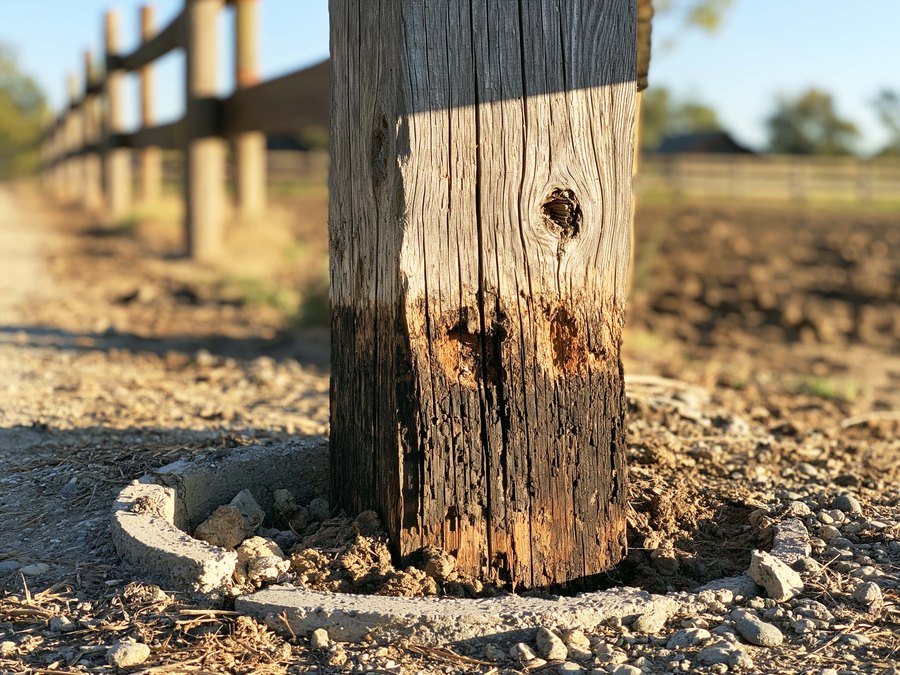
Each of them goes a post at a time. A fence built in a single week fails post by post across several years, so this question will come up more than once on your property.
When replacing beats repairing twice. Sometimes the answer really is the whole fence, and hearing it early saves you paying for it twice. There's a second version that has nothing to do with condition: a perfectly sound fence that does the wrong job for you. Too short for a dog that's worked out how to get over it, or solid where the view is the best thing about the lot. We'll say so rather than take the smaller job.
Either way you'll hear which it is on the day, with the reason attached, before any price exists. Most of that comes out of ten minutes walking the line with you, which is why the first visit costs nothing.
Posts decide a fence repair, so we count them first. We put a shoulder into every post along your line and mark the ones that move, and that count carries more of your estimate than everything under it.
Boards, mesh and hardware go on cheap and quick. Setting a post is neither, which is how two jobs that look the same from your street end up an afternoon apart.
We call in the utility locate, which matters more on a fence than a wall. Posts land in a straight line across a yard and irrigation tends to be laid in the same place. We settle the property line with you, since a fence sitting on it is half your neighbor's. And we check the permit: Queen Creek requires one for fences and walls with no height exemption, and a like-for-like repair is different paperwork from a new fence. The inspector has the final say.
The failed part comes out whole rather than broken back roughly, so what goes in has something square to key into. Your new post goes deeper than the one that came out, because the depth is usually why it came out in the first place. Where the hole meets caliche we open it up properly. Trimming the post to suit the hole is the commonest shortcut on a fence and it guarantees you a second visit.
Then the matching. New wood beside fifteen-year-old wood is a different color for a couple of years, so we put the sound boards on the side you see and the new ones where they face the alley. Slack chain link sits badly beside a piece that isn't, so the new piece gets pulled to work with the old. On metal we finish the repair to the sheen of what's beside it.
And we look at your gate before we leave, whether or not it was part of the job. It's the part you touch every day.
Nearly always one section. A wood fence fails at the post, and posts fail one at a time, because each sits in slightly different ground with different water reaching it. The boards above are usually sound, which is why a fence flat on the ground after a storm often goes back up with one new post and a few boards. The exception is when you lean on the posts down the whole line and most of them give.
Almost always, because metal fails in a small place. Steel here corrodes from the bottom up, where the coating is thinnest and the sprinklers land, so what you're usually looking at is the last few inches of an upright that's otherwise fine. That's a cut, a splice and a repaint rather than a new fence. It stops being worth it when the corrosion has gone right through in several places, or when the material was thin-walled to start with.
Usually yes, and better than you'd expect. Chain link is one of the most standardized things in the trade, so the mesh, posts and fittings still come in the sizes they came in thirty years ago. The color won't match at first. Galvanized mesh goes a soft gray over the years while new mesh is bright, so a repaired piece stands out for a season before it settles in. Where that matters we'll put the older mesh on the visible side.
One post reset with a few boards back on runs $200 to $450. A multi-post job, or a whole section back in the ground, runs $600 to $1,500. On its own a post is $150 to $400, and the post is nearly always what you're paying for, because boards and hardware go on cheap and quick. From the street those two jobs look the same. That's why we put a shoulder into every post before anything gets written down.
That depends on the storm, and we'd rather say so than give you a time we can't keep. A monsoon night that takes fences down across the southeast valley fills a schedule in a few hours. Anything that's left a property open, a fence down where a dog or a small child can get out, goes ahead of cosmetic damage. And you'll be told where you actually stand in the line.
Yes, and it's most of what we do. Repair work almost never goes back to whoever built the fence. Fifteen years is long enough for a builder to have moved on, and tract fencing went in under a subcontractor whose name nobody kept. So the normal job here is a fence with no history attached, which is why we start by working out what yours is made of and how it went together.
Wire mesh and steel posts on property lines and work sites, put back straight.
Chain link fence repair →A new fence rather than a repair, and how to tell good product from cheap.
Vinyl and wood fence →Farm ground and subdivision on the same street, aging at different rates.
Coolidge →
Free, no obligation
A photograph of what came down, and one of the base of the nearest post still standing, usually tells us which job this is before anybody drives out to you.
