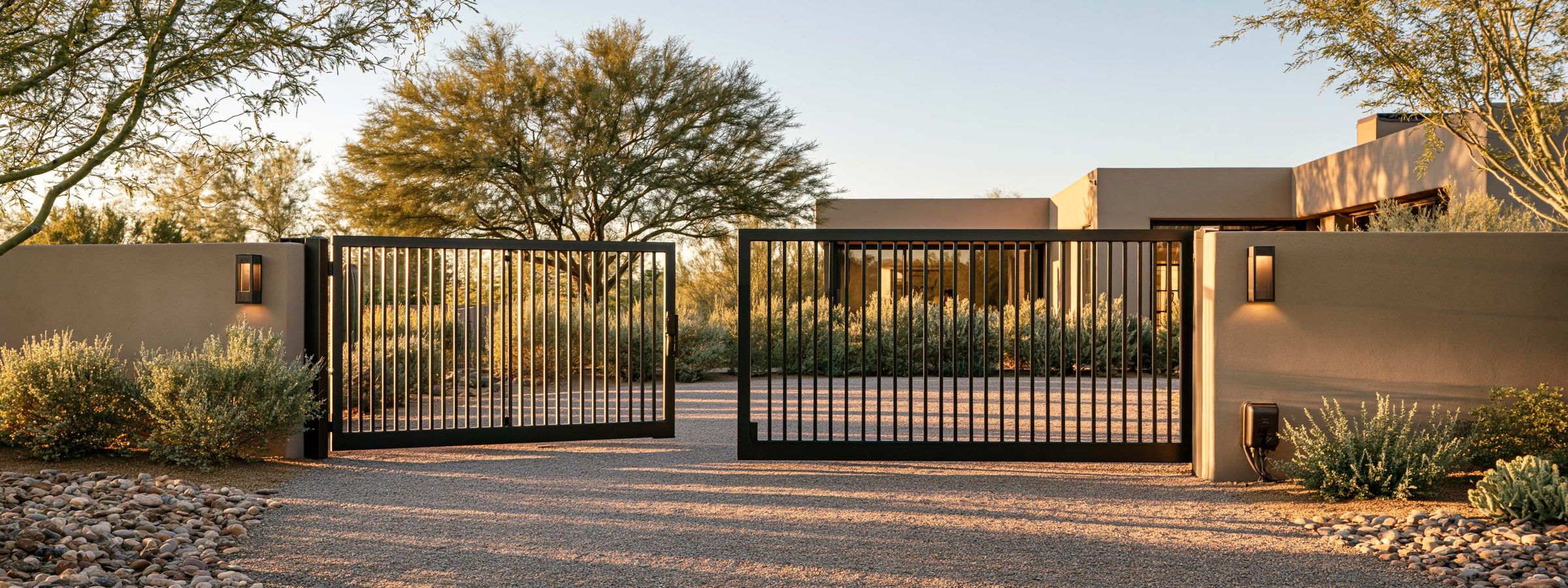
Usually it's one part, not the whole system. We test before we quote, so you aren't paying for a control board when it's the battery.
An automatic gate almost never dies all at once. Yours probably started by stopping halfway, then worked every morning and refused after dark, then behaved perfectly for a week.
Five things commonly stop working on a residential gate. They're all replaceable on their own, and only one of them is expensive. People end up buying a whole new system because nobody worked out which of the five they had.
So read the symptoms below before you call anybody. Two or three sentences about what your gate is actually doing will get us most of the way there. And on two of the five, you'll know before we arrive that you're looking at the cheap end of the list. Queen Creek Fence Company reads your symptom before it reads a catalog, because on automatic gate repair the part everybody blames is hardly ever the part that quit.
An automatic gate is simpler than it looks. There's a machine that pushes your gate, a board that decides when, a couple of sensors that stop it hurting anybody, something that tells it where to stop, and power feeding all of it.
In plain words: the operator is the machine itself, the arm or housing bolted beside your gate. The control board is the small electronic board inside it. A photo eye is the beam across your driveway that stops the gate if something's in the way. A safety loop is a wire buried in the drive that senses a vehicle over it. A limit switch tells your gate where open and closed are.
Four patterns cover most of what we get called out to:
The fifth pattern gives you nothing at all: no lights, no sound, no response from the keypad. That's power or the control board, and we tell those apart in about a minute with a meter, so you know which one you're buying before anything gets ordered.
Most people tell us on the phone that their operator has burned out. Usually it hasn't. An operator is a slow, simple, heavily built machine and it's the most durable thing you own out there. What fails around it is everything cheaper than it.
Your gate decides how long the machine lasts. The operator was sized for a gate that swings freely. If a pivot has stiffened, a wheel is scraping the driveway or the far corner has dropped, your machine works harder on every cycle. A residential gate cycles a few thousand times a year, so any extra load gets paid for a few thousand times over.
Which means the operators that fail early were usually sitting behind a gate that needed attention first. Replace the machine without dealing with the gate and you'll buy the same failure again. When one has died young we pull it off and swing your gate by hand before we say anything else.
Power, and the long driveway problem. There are a lot of acre lots around here, which means a lot of gates a long way from the house. Running mains power out across a hundred and fifty feet of desert is a real piece of work, so a large share of the gates here run on solar.
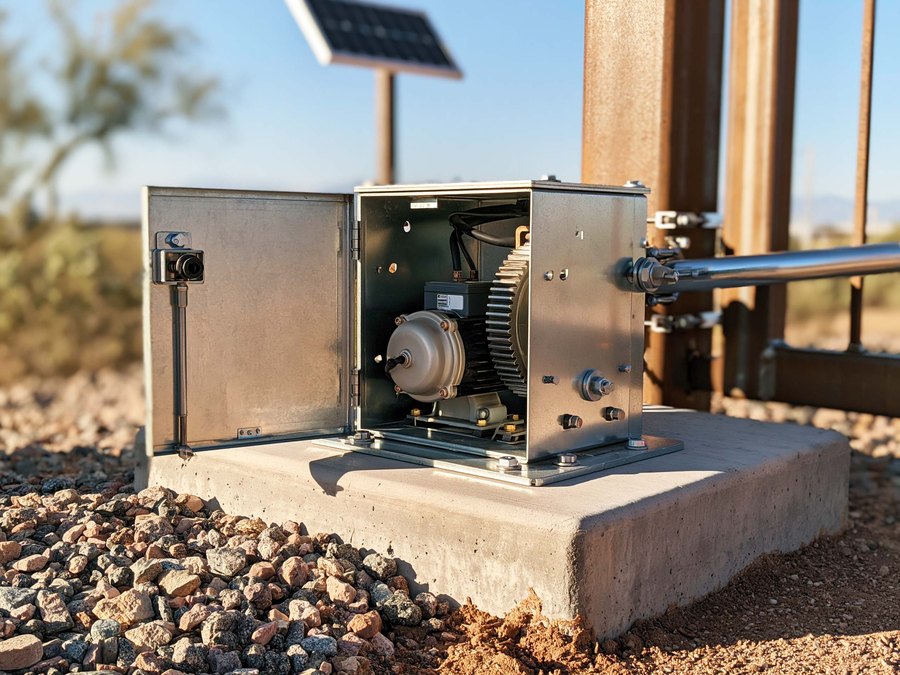
A solar system is a battery topped up during the day, and batteries wear out on their own schedule. The classic version is a gate that's been faultless for three years and now works all day and refuses at ten at night. Nothing on it is broken. The battery just can't carry the evening any more, and that's a part rather than a system.
Every gate out here should also have a manual release you can reach without a ladder or a tool, so a dead battery never leaves you standing outside your own property. We check yours works and show you where it is, whatever we came out for.
Which of the five parts quit decides this estimate, and we settle that with a meter on the first visit. The same complaint can turn out to be a battery or a control board, and those two are nowhere near each other on your estimate.
The bigger question underneath is whether the fault sits in your equipment or in the gate the equipment is bolted to. Equipment means a part. A gate that's been making the machine work too hard is a second piece of work. Finding that out on the first visit costs you far less than finding it out after a new operator has gone on.
You're welcome to stand there while it happens. We clear the cheap possibilities before the expensive ones.
Power first, at the source and then at the board, because a flat battery imitates half a dozen other faults. Nothing wastes more of your money than a control board fitted to a gate that was out of charge. Then the safety devices one at a time: we break the photo eye beam deliberately and watch how your gate reacts, and check each loop with a vehicle over it and without.
Then the gate comes off the machine and gets swung by hand, which tells us in one push whether the operator has been fighting it. Only then do we read the limit switches and force settings. And we read them before we touch them.
Most visits end with a part: a photo eye, a battery, a limit switch, a board, or settings put back where they belong. Replacing the whole operator is right in three cases. It's genuinely worn out, it was undersized for your gate from the day it went in, or it's old enough that parts aren't made any more. In that last case we'll say so rather than chase a part around the state for three weeks.
A new operator will never be our answer to a gate problem. If your gate is what's wrong, we deal with the gate and put the machine back on afterward, working less hard than it was.
Most of these land between $150 and $900, and where you fall depends on which of the five quit. A photo eye realigned or replaced runs $75 to $300. A battery on a solar gate is $100 to $250. A control board is the expensive one at $300 to $900, and it's also the least common of the five. Replacing the whole operator is a different order of thing at $1,200 to $3,500, and we'll say plainly when your gate is genuinely at that point. The visit that finds out costs you nothing.
Five, in a fairly predictable order. Safety devices lead by a long way: a photo eye knocked out of line, or a loop cut by somebody trenching for irrigation. Then power, which on the solar systems common out here means a battery reaching the end of its life. Then the limit switch, which drifts and leaves your gate stopping in the wrong place. Then the control board, the expensive one and the least common. And underneath all four, a gate that's become harder to move and has been quietly wearing the machine out.
Ask what happens on the first visit. Anyone who plans to diagnose will describe testing the power, then the safety devices, then the gate, and will give you that order before they arrive. Ask whether they'll disconnect the machine and swing your gate by hand, because that one test tells you whether the gate or the equipment is doing the damage. And ask who handles it if the gate turns out to be the problem.
Almost always the photo eye. Your gate is designed to refuse to close when it thinks something is in the way, which is exactly what it's doing. Look for the small lens on each side of your driveway, check it for a spider web or dust, and check whether a vehicle or a shifted post has knocked one out of line. On a gate with a safety loop the same thing happens when the buried wire is damaged. Either way it's working correctly on bad information, and that's a cheap fault to put right.
We do, both halves. A wide RV gate with power on it is two trades stacked, and you get bounced between them constantly. A common version is a wide pair of leaves that no longer meet in the middle, where the equipment gets the blame and the masonry is the cause. Because we build the walls too, we find that on the first visit rather than after somebody has replaced a perfectly good operator.
We treat a gate stuck open as urgent, because that's your property standing wide open. We come out as soon as we can, and how soon depends on what's already booked. A fault in the safety devices, the settings or the power normally gets sorted on the visit. A control board or an operator for an older system may need a part ordered in, so describing the symptom when you call is what lets us bring the likely part along.
The metal half of a property, repaired, recoated or replaced.
Wrought iron and view fence →
Free, no obligation
One sentence describing exactly when it misbehaves is worth more to us than a guess at the part, and it usually means we can bring the likely one with us.
