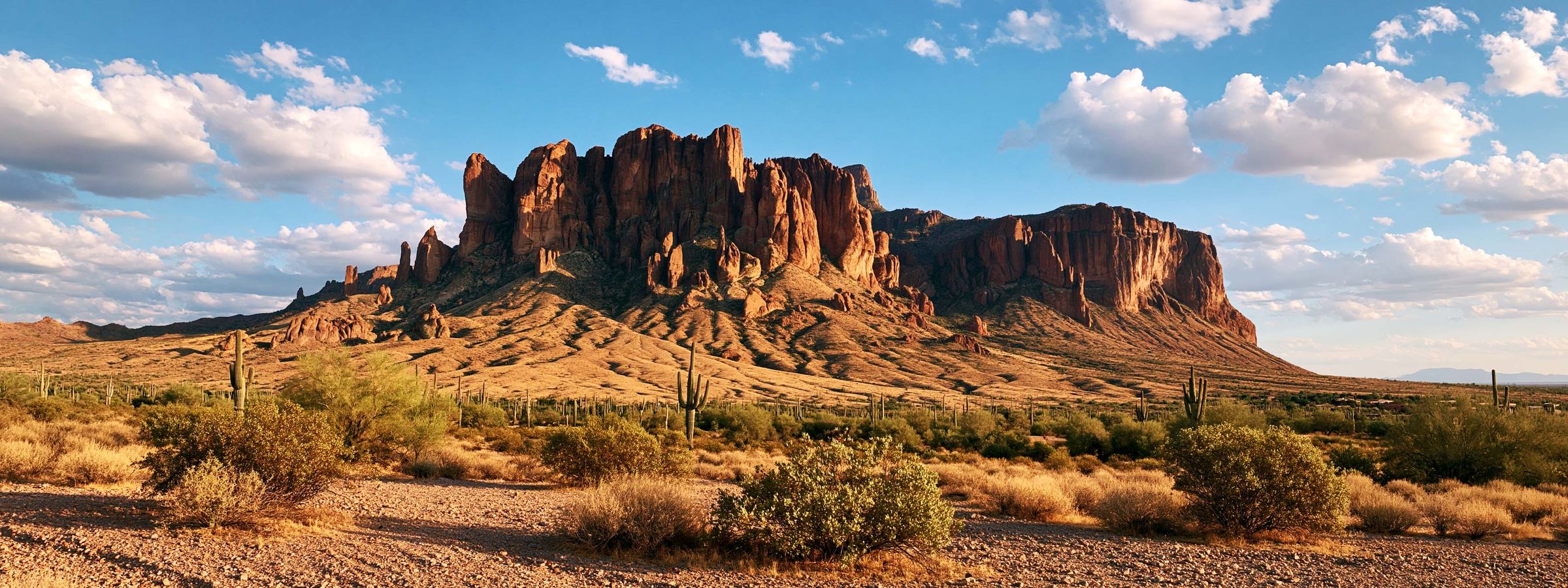
Fencing Built for the Lots This Town Actually Has
Manufactured-home lots, acre parcels and horse ground each need a different fence. We'll walk yours and quote it as its own job.
If you own a manufactured home here, you're in good company. Around 45 percent of the housing units in Apache Junction are manufactured homes. That matters when you're getting a fence quoted, because a contractor who only works tract subdivisions will price your lot like a tract lot, and it isn't one. Queen Creek Fence Company works all three of those lots every week, and that is what you want from a fence company Apache Junction, AZ homeowners call twice.
Three things change on your lot:
The median home in Apache Junction dates to 1994, so most of the fencing in town is thirty years old and change. At that age you'll usually see the same three things: line posts starting to lean, fabric pulling away from the top rail, and a gate that won't meet its latch. We fix all three in place, and we'd rather do that than sell you a fence you don't need.
Nearly three percent of the housing units here are recreational vehicles, and a lot more households park one on the lot. If that's you, we cut RV gates into block wall constantly out here. The wall above the new opening has to be carried, and the posts on each side have to take a gate wide enough for a fifth wheel. We set them deeper than your fence line calls for.
If you're on horse ground, the rules change before the fence does. Three of the town's residential districts allow large livestock. RS-GR sets no head limit, and RS-54 allows one head per half acre. You'll need at least 1.25 gross acres, and any structure housing them sits 50 feet off every line.
Two things follow, and both are good news for your budget. Pipe rail and chain link do the work block does in a subdivision, because a horse needs to see a fence and needs it to give under a shoulder. And your gates get wider and heavier, which moves the cost from the panel to the post.
We'll take care of the fencing and the gates around your house and along your road frontage. Corrals and arena layout go to somebody who does that all day.
Before we dig on a larger parcel, we check the Arizona Geological Survey's earth fissure planning map for the Apache Junction study area. Fissures open where groundwater pumping has let the land settle, and they run long and erode fast once they start.
For most properties it changes nothing at all. For a few it changes everything, and ten minutes of looking tells us which one you've got. It costs you nothing to have us check.
Apache Junction sits on open bajada with very little between your lot and the weather, so a monsoon microburst puts the whole load on your fence at once. Wind finds the post that was already weak at the dirt line, which is why the panel lying in your yard is the symptom and not the cause. We dig at the post first.
The ground out here runs coarse, with caliche under a lot of it, and that cuts both ways. Caliche holds a post beautifully once it goes in right, and it makes the hole slower to dig than a quote written for soft ground assumes. Stop a hole at the caliche and fill it anyway and you've got a bucket holding water against your post.
Plenty of fences here have no neighbor to match and no theme wall to continue, so the choice comes back to you. Keeping stock in, keeping traffic out and marking a line are three different fences, and we'll ask which one you're after before we price it.
If you've got a pool, Arizona's barrier law covers any water eighteen inches deep and wider than eight feet, above ground included. The details that fail an inspection are small ones. How high your latch sits. Which way your gate swings. The gap under your bottom rail. None of those costs you anything extra to get right the first time, and all of them cost real money to find afterward.
On a manufactured-home lot there's one question worth raising early: where your barrier ties in, and what it ties into. That's five minutes standing in your yard with us, and considerably longer after a failed inspection. Local rules can be stricter than the state minimum and the inspector has the final say.
Chain link repair and installation take the bulk of our week here. Fence repair and RV gates come next, because the wide lots ask for both. After that it's gate repair, block wall repair on the subdivision side of town, and wrought iron where you want the view kept.
On a repair we'll walk the whole length with you and mark every post that has moved. Usually most of them haven't, so your bill covers the part that failed and you keep the rest of the fence you already paid for.
Apache Junction runs its own land development code, which means the Pinal County allowances that cover Gold Canyon stop at the city line. We'll pull the permit and file the paperwork where one applies, and tell you which it is before anybody digs. Rules change and the inspector has the final say.
Apache Junction and the surrounding southeast valley
