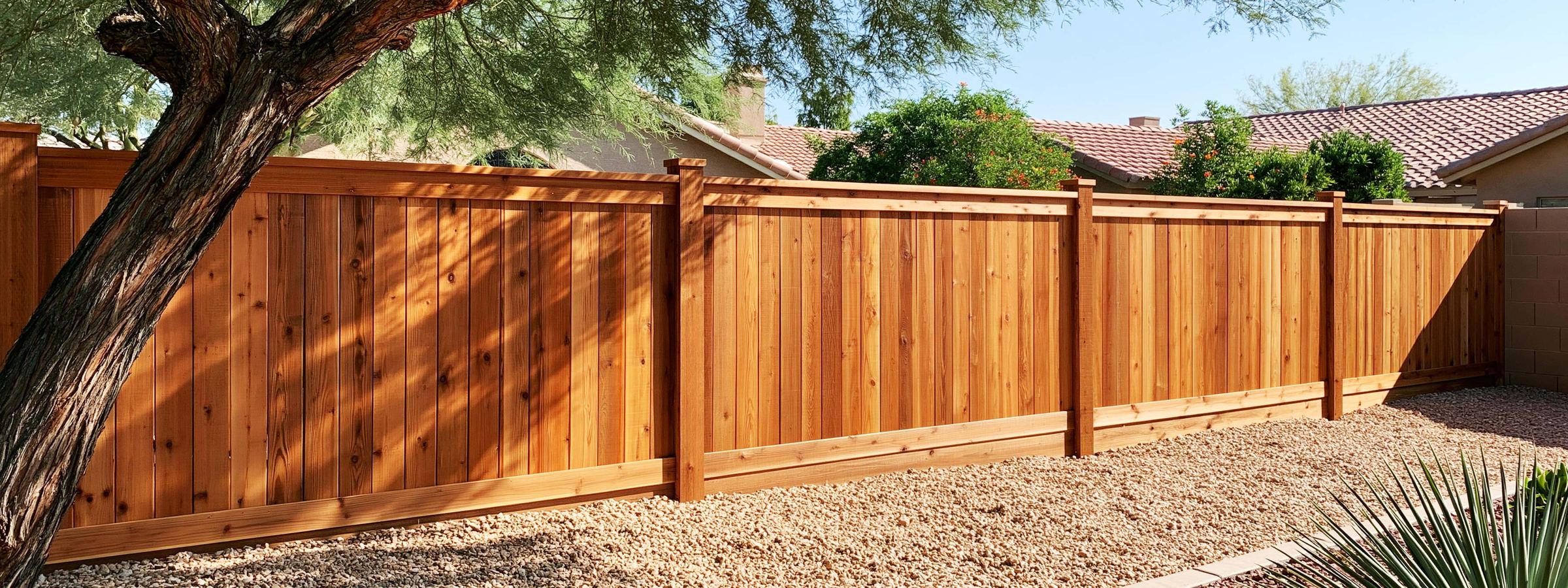
Wood lasts here. It just asks something of you every few years, and we'll tell you plainly whether your fence line is one that should get it.
Somebody has already told you it won't. A neighbor, a builder, or the internet. It's the single most asked question about wood in this valley, and it deserves a straight answer rather than a brochure.
Wood lasts here. What it won't do is last here while being ignored. A wood fence in Queen Creek is a fence you seal every two or three years. The sun on your west-facing side will want that attention long before the north side asks for anything. Every failed wood fence any of us has ever seen out here is a fence nobody did that to.
So the real question isn't whether wood survives. It's whether the particular stretch you have in mind is one worth spending it on. We'd rather say that at the curb than build you something you resent in six years. Queen Creek Fence Company will walk your line before quoting a wood fence installation, and on some lines the honest answer is that your money belongs in block or steel instead.
Here's the thing almost nobody tells you before you start pricing.
You probably aren't fencing a property in wood. Most houses here were built since 2000 and came with block around the perimeter, and Queen Creek's design standards decide what your street-facing fence is allowed to be and what it has to match. So wood in this town is almost never the whole yard. It's a side yard between you and one neighbor. A courtyard. A divider that gives one patio some privacy from another. A stretch behind the garage. A gate. The infill on a wide gate where you wanted something solid.
That changes the arithmetic completely. A hundred feet of wood is a project. Twenty-two feet of wood between your patio and the neighbor's window is an afternoon, and it's the job wood is best at in this climate, because those short stretches are usually the shaded ones.
Shade is worth more than species. Two identical cedar fences on the same street will not age the same way. Put one against a west wall in full afternoon sun and the other on a north line under a mesquite, and by year eight they are two different fences. Not close. Before we talk to you about wood at all, we want to know which way your stretch faces and what stands over it. That's a thirty second conversation and it decides most of the rest.
Nothing dramatic happens. That's what makes it easy to put off.
First the color goes. Cedar and redwood both start warm and both end up silver-gray, and in this light that happens faster than the label suggests. Plenty of people like the gray. If you're one of them, say so early, because it changes what we recommend and what you spend.
Then the boards start to move. Wood gives up moisture in dry heat, and as it does the faces cup, the edges lift and fine splits open along the grain. The trade calls that checking. It isn't rot and it isn't a defect. It's timber doing what timber does, and it's the thing sealing slows down.
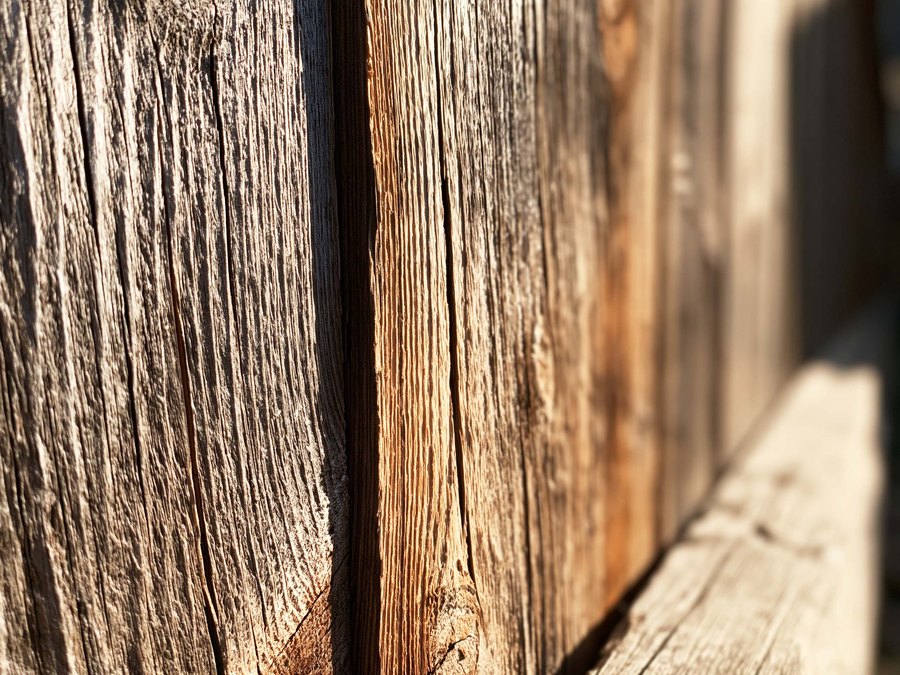
The posts go last and they go from underneath. Whatever is above the dirt is drying out. What sits in the dirt is doing the opposite every time your irrigation comes on. That's where a wood fence in Arizona actually ends, at the few inches where the post meets its concrete, and it's why the sprinkler beside your fence matters more than the species you picked.
Termites are real here and they aren't the main event. Arizona has subterranean termites and they'll take an untreated post that stays damp. Cedar and redwood carry oils that discourage them, and treated pine carries chemistry that does the same. Keep the wood out of standing water and the problem mostly stops being one.
Wood costs $17 to $35 a foot installed around here. Treated pine sits at the bottom of that, cedar in the middle, redwood at the top. A hundred feet of six foot privacy fence is therefore roughly $1,700 to $3,500, which is the answer to the question most people are actually asking when they call.
Two honest notes on that band. Short stretches cost more per foot than long ones, because the setup, the delivery and the first post cost the same whether you're building twenty feet or two hundred. And a fence replacing an old one carries the cost of getting the old one and its concrete out first.
Three real choices and they aren't close in price.
Treated pine is the value answer and most of the wood fence in this valley is exactly that. It takes the chemistry that keeps rot and insects out, it costs the least to put up, and it wants sealing more often than the other two. Built well and looked after, it isn't a compromise.
Cedar is the middle and the one most people picture. It moves less as it dries, it holds a finish better, it smells like a fence should, and it carries its own resistance without being treated. It costs more and it's worth it on a stretch you'll look at every day.
Redwood is the top and it's a genuine luxury here rather than a necessity. If you want it, you already know.
A number of years is the one thing we won't put on paper for you. Search it and you'll be told fifteen by one result and forty by the next, and neither figure is describing a fence in Queen Creek with a sprinkler pointed at it. The species sets the floor. Everything above the floor is shade, water and whether anybody seals it.
Five things separate a wood fence that ages well from one that doesn't:
Figure $1,700 to $3,500 for a hundred feet of six foot privacy fence installed. Treated pine lands near the bottom, cedar toward the top, redwood above it. What moves you inside that band is height, whether the boards sit tight or spaced, how many gates you want, and whether an old fence has to come out first. A short stretch costs more per foot than a long one, so twenty feet won't simply be a fifth of the price of a hundred.
Cedar for most people, treated pine if the budget leads, redwood if you want the best and know it. Any of the three will stand up here. But the species is the smallest of the decisions you're making. A treated pine fence on a shaded north line, sealed on schedule, will comfortably outlive a cedar fence baking on a west wall that nobody ever touched. Pick the wood second. Pick the stretch first.
Yes, and the honest version of that answer has a condition attached. Wood here needs sealing every two or three years, the west and south faces need it first, and the wood has to be kept out of standing water at the bottom. Do those and a wood fence has a long life in this valley. Skip them and the sun will have the finish off inside two summers and the boards moving inside four. Anyone who tells you wood is maintenance free in Arizona is selling you something.
Every two to three years is the working figure for this climate, and it's worth thinking of it as per face rather than per fence. Your west-facing stretch will be ready before the rest of it is, and there's nothing wrong with doing that side on its own schedule. The tell is water: splash some on the boards, and when it soaks in rather than beading, the finish has gone.
The answer turns on something specific rather than on taste. Wood gives you a solid fence at a lower price than almost anything else, in any height and any shape without a catalog. You can repair it one board at a time with a drill. What it asks is a weekend every few years. If that trade sounds fine, wood is a lovely fence and we'll build you a good one. If you know you'll never get to it, we'll tell you so at the curb and price you something that doesn't need you.
Yes, and it's one of the commonest wood jobs in this town. Most lots here already have block around the outside, so your wood goes in as a divider, a courtyard, a side yard stretch or the infill on a gate. Where wood meets masonry the detail matters more than the fence does: the timber has to be held off the block rather than tight against it, so water isn't trapped between the two. That join is where these jobs are won or lost.
Free, no obligation
North, south, east or west, and whether anything shades it. That one sentence tells us more about your wood fence than the length does.
