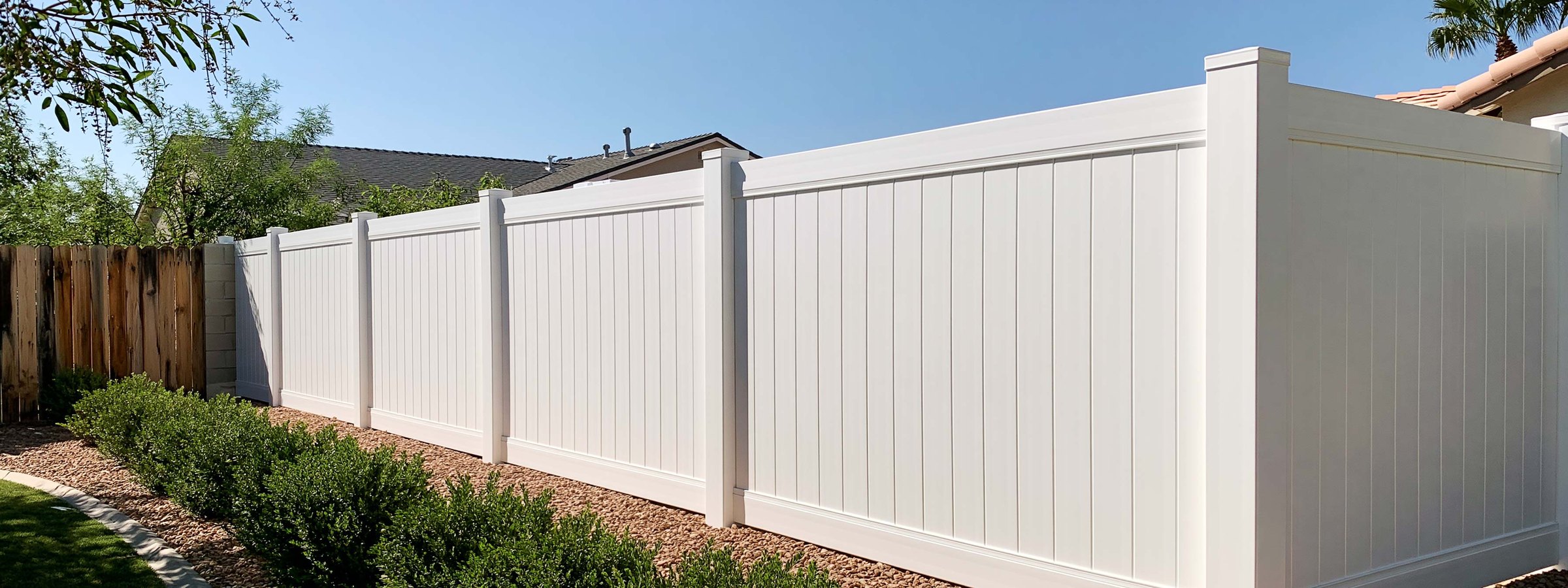
Vinyl is either the best value on this list or the worst, and the grade of the material decides which. We'll write that grade on your estimate.
Most people get here one of two ways. Either the wood fence out back wants painting again and you've decided that was the last time. Or you've got a quote in your hand that came in lower than you expected, and you're wondering where the catch is.
If it's the second one, we're not going to tell you that quote is bad. We'll tell you the three lines to look for on it. If they're on there, buy it.
Because vinyl isn't one product. Two fences that look identical standing in your yard can be built to very different specifications, and you won't see which is which for about three summers. Everything white looks white when it's new. Queen Creek Fence Company writes the grade on the face of a vinyl fence installation estimate, because that line decides more about how your fence ages than anything else.
We build wood too, and we'd rather build you a good wood fence than a cheap vinyl one. We'll price both side by side with the trade-offs written down.
Nothing dramatic happens. Your fence just finishes each summer a little further from where it started, and whether that matters in year ten was settled the day the material was made.
UV takes the color before it takes the plastic. Vinyl on its own has no defense against ultraviolet light. Left untreated it chalks, yellows and goes brittle, and out here that clock runs faster than almost anywhere. What holds it off is what the manufacturer put in the mix: titanium dioxide to take the UV, impact modifiers to stop the material going glassy after a few years in your sun.
That additive package is the single biggest difference between two fences that look the same in a display rack, and it's the one thing you can't see standing there. A quote priced well under the others usually saved it right there, and that saving won't show up in your yard for three years.
The small gaps aren't sloppy work. Vinyl grows and shrinks with temperature far more than wood or steel does. Across one Queen Creek summer day your fence goes from cool at dawn to too hot to keep your hand on. Down the length of a back yard, that adds up to a real distance.
So a properly built vinyl fence has an expansion gap designed into it, and the uprights aren't screwed hard into the horizontals. If you've seen a small gap at the end of each horizontal and assumed somebody got careless. That gap is the reason the fence is still straight. Built without it, the material buckles or pops apart at the joins in July.
Four things worth checking on any quote you're handed, whoever wrote it:
There's no universal answer here, and that's good news for you. Vinyl is very good at one particular job and unremarkable at the rest, and knowing which one you have is the whole decision.
Where it isn't the answer. A short stretch you will look at every day, in a shaded yard, where you want something you can alter later. Timber does that better and costs less to put in, and it asks a weekend of you every few years in exchange. We build both and we will price them side by side with the trade-offs written down.
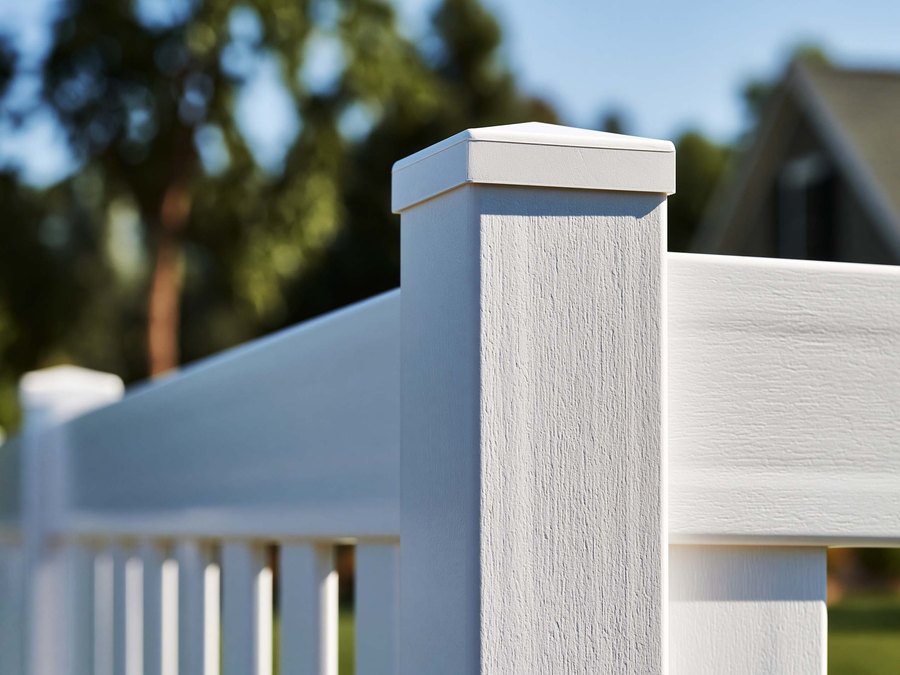
Where vinyl earns its price. The long boring stretch. Your back property line facing full west, on a yard where nobody wants to be out there with a sprayer every third spring. That's what the material was made for. It doesn't want painting, the color goes all the way through, and dirt comes off with a hose.
It also stays where you put it, which counts for more here than people expect. Built to the right grade with the right gaps, vinyl doesn't move with the seasons the way wood does, so your gates keep working and the line stays true. That's the real argument for it.
The honest limitation. Vinyl doesn't forgive a repair. Damage in one place usually means taking apart more of your fence than the damage itself, and getting an older white to agree with a new white isn't always possible.
Grade carries this estimate, and two fences that both get called vinyl can sit a long way apart on it. So ours names the grade, the rail spec and the post depth on the face of it, where you can hold it up against anything else you've been quoted.
What's worth comparing isn't the total. It's what the total buys.
Two documents decide more about your fence than the material does, and we get hold of both before anything is ordered. Queen Creek requires a permit for fences and walls, with no height exemption. And where a fence faces a public street, the design standards ask that it match the materials and main color of the standard plan or the subdivision theme wall. In some neighborhoods that's a real constraint on white vinyl. In others it won't touch you. The inspector has the final say.
We ask what your HOA has to say too, because in a town this new the answer usually arrives as a document rather than an opinion. We walk the property line with you, call in the utility locate, and file the permit either way.
Then the posts, because everything follows them. We set them to a string line before a single upright arrives. Depth comes off the height of your fence and the ground it's going into, not off the length of post that came on the truck. We crown the concrete at the top so water sheds away from it.
And then we build it to move. Expansion gaps at the ends of the horizontals, uprights left free to slide a little in their routed holes, hardware that isn't torqued down onto the material. On wood the equivalent is leaving the boards room and using fasteners that'll still be there after the timber has moved twice.
Last is the line itself. A fence that's straight when you sight along it from the corner is most of what you'll ever notice about it, and the string and the posts settle that before anything else goes up.
A hundred feet installed runs $2,500 to $5,000 here. Nearly the whole spread inside that band is product grade, which is why two honest quotes for the same fence can sit half apart. Your money goes to three places. The grade carries the biggest line, post depth comes second, and corners, ends and gates cost more than the straight yards between them. Ask any quote to name those three and you can hold it against any other.
Three real ones, and all three belong to the material itself. It isn't forgiving to repair the way wood is, so damage in one place usually means taking apart more than the damage. Getting an older white to agree with a new white is unreliable. And the cheap end of the market is genuinely poor in this climate, so your money goes further at the grade above it. None of those rule it out. They're the reasons to buy the grade rather than the price.
Three lines, and the price isn't one of them. First, find the wall thickness and the rail spec on the quote. That's the difference between a fence still square in year ten and one that isn't, and it's the line most quotes leave off. Second, ask who actually does the work. That kind of quote is usually a material price with the installation subcontracted, which means your product decisions and your ground decisions get made by two different companies. Third, ask what happens at the post: how deep the holes go, and what they do when they hit caliche. All of that can be perfectly fine. It just means asking the questions on this page twice rather than once, and we'd rather you asked us them too.
They're aimed at different things. Composite, which is what Trex is, blends wood and plastic, so it's heavier, reads more like timber and holds a darker color. Vinyl weighs less, costs less to install and asks nothing of you afterward. In this sun the question you put to either one is the same. What's in it to stop UV taking the color, and how is it built to move when the afternoon heat gets into it?
Vinyl commits you to a look. White or almond or gray, smooth, uniform, and it doesn't change. If you like a fence that weathers, this is the wrong product for you. It shows dust in a way wood doesn't, which around here means a hose twice a year. And it dates a yard the way a kitchen dates a house. The profile that reads as current now will read as of its time later.
Ask what you want the fence to ask of you. Vinyl wants nothing and gives you a long uniform stretch that stays where you put it, which is what it was made for. Timber wants a weekend every few years and gives you a fence you can alter, repair a board at a time, and buy for less up front. Neither is the better product. They answer different questions, and the one worth asking first is whether you will actually do the upkeep. We build both, and we'd far rather build you a good fence in the material that suits you than a cheap one in the material you asked for.
A post gone over or boards down after a storm, priced by what actually failed.
Fence repair →View fence in steel, and where it gives out first in this climate.
Wrought iron and view fence →Adding to a block wall, or building one where a fence will not do.
Block wall construction →New yards on open ground, with full west exposure and nothing shading them.
San Tan Valley →
Free, no obligation
The distance, the height you want and which way your fence faces are enough to put a real comparison in front of you rather than a bare price.
